Ratha Yatra—also known as the Festival of Chariots—is one of the oldest, largest, and most iconic religious gatherings on Earth. Celebrated annually in the coastal city of Puri, Odisha, this sacred festival marks the public procession of Lord Jagannath (a form of Lord Vishnu), alongside his elder brother Lord Balabhadra and sister Goddess Subhadra.
Unlike most Hindu traditions where deities remain enshrined within the sanctum sanctorum of the temple, during Ratha Yatra the lords step outside the 12th-century Jagannath Temple to meet their devotees regardless of caste, creed, or background.
Mythological & Historical Origins
The roots of Ratha Yatra span several millennia and are documented in ancient scriptures like the Skanda Purana, Brahma Purana, and Padma Purana.
According to tradition, the festival commemorates the annual journey of Lord Jagannath and his siblings to their birthplace, the Gundicha Temple, located roughly 3 kilometers away along the Grand Road (Bada Danda).
┌────────────────────────────────────────────────────────────────────────┐
│                        THE 9-DAY JOURNEY ROUTE                         │
├────────────────────────────────────────────────────────────────────────┤
│ Shree Jagannath Temple  ──►  Bada Danda (Grand Road)  ──►  Gundicha    │
│  (Srimandir Sanctum)           (Public Procession)         Temple      │
│                                                                        │
│  ◄─────────────────────────── 9 Days Residence ───────────◄            │
│                       (Bahuda Yatra - Return Journey)                  │
└────────────────────────────────────────────────────────────────────────┘
The festival also carries a poignant legend: Queen Gundicha, the wife of King Indradyumna who originally built the Jagannath Temple, requested that the deities visit her home once a year. Lord Jagannath granted her wish, making Gundicha Temple their maternal home (Mausi Maa Temple).
The Three Majestic Chariots (Rathas)
A defining engineering and spiritual feat of Ratha Yatra is the construction of three new massive wooden chariots every single year. The construction begins months in advance on the auspicious day of Akshaya Tritiya, using precise traditional measurements passed down through generations—without a single blueprint or modern nail.
| Attribute | Nandighosha (Jagannath) | Taladhwaja (Balabhadra) | Darpadalana (Subhadra) |
| Chariot Height | 45.6 feet | 45 feet | 44.6 feet |
| Number of Wheels | 16 large wheels | 14 large wheels | 12 large wheels |
| Canopy Colors | Red & Yellow | Red & Blue | Red & Black |
| Charioteer (Sarathi) | Daruka | Matali | Arjuna |
| Sacred Wood Pieces | 832 timber logs | 763 timber logs | 712 timber logs |
Cultural & Universal Significance
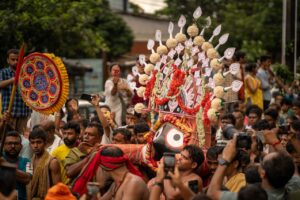
What makes Ratha Yatra globally unique is its egalitarian ethos. In traditional Vedic temples, entry rules can be restrictive. However, during Ratha Yatra:
-
Universal Access: Lord Jagannath comes out into the open street so that people of all faiths, nationalities, and backgrounds can behold his large, round eyes (Chaka Nayan).
-
Community Unity: The gigantic chariots move strictly by collective human power, uniting millions of strangers pulling in unison.
-
Global Celebrations: Through the International Society for Krishna Consciousness (ISKCON) and Odia diaspora organizations, Ratha Yatra is now celebrated in over 100 cities worldwide, including London, New York, San Francisco, Tokyo, and Moscow.
Visiting Puri During Ratha Yatra: Quick Guide
-
When to Go: The festival takes place during the Hindu lunar month of Ashadha (typically June or July).
-
Location: Grand Road (Bada Danda), Puri, Odisha, India.
-
Pro Tip for Travelers: Book accommodation at least 4 to 6 months in advance. Rooftop viewing spots along Bada Danda offer the best panoramic vantage points to witness the sweeping crowd and chariot pulling safely.