Dhanu Jatra (or Dhanu Yatra) is a magnificent 11-day theatrical festival held annually in the town of Bargarh, Western Odisha. Officially spread across a 8 km radius, it holds a place in the Guinness Book of World Records as the world’s largest open-air theater.
Celebrated during the Hindu lunar month of Pausha (typically late December to early January), the festival transforms the entire geography of Bargarh and surrounding areas into the ancient mythological kingdoms of Mathura and Gopapura. There are no fixed stage walls or audience seats—the entire municipality, its streets, markets, and rivers become a living stage, and its residents become active participants in the drama.
Historical Origins & Evolution
Dhanu Jatra originated in 1948, shortly after India gained independence. Local labor union workers and artists started the festival to celebrate freedom from British colonial rule. The defeat of the tyrannical King Kansa at the hands of Lord Krishna was chosen as a symbolic narrative for the triumph of justice, democracy, and righteousness (Dharma) over oppression.
┌────────────────────────────────────────────────────────────────────────┐
│                     THE GEOGRAPHIC TRANSFORMATIONS                     │
├────────────────────────────────────────────────────────────────────────┤
│ • Bargarh Town      ──► Transforms into Mathura Nagari (Kansa's state) │
│ • Ambapali Village  ──► Transforms into Gopapura (Krishna's home)      │
│ • Jeera River       ──► Transforms into Sacred River Yamuna            │
│ • Hatpada Market    ──► Raj Darbar (Royal Court of King Kansa)         │
└────────────────────────────────────────────────────────────────────────┘
Unique Geography of the Drama
What sets Dhanu Jatra apart from conventional theatrical acts is that the entire city functions as a set:
-
Mathura (Bargarh Town): The main town area represents King Kansa’s capital. The local vegetable market serves as the primary stage (Hatpada Raj Darbar) where Kansa holds daily royal court.
-
Gopapura (Ambapali Village): Located across the Jeera River, this village is decorated with traditional wall paintings depicting Krishna’s childhood. Villagers paint their homes and act as gopis and cowherds.
-
River Yamuna (Jeera River): The river separating Bargarh and Ambapali acts as the sacred River Yamuna. Real boat rides depict Vasudeva crossing the river with infant Krishna, as well as Akrura bringing Krishna and Balarama to Mathura.
The Rule of King Kansa
The defining highlight of Dhanu Jatra is the supreme authority given to the actor playing King Kansa. For 11 days, the actor rides a decorated elephant through the streets of “Mathura,” inspecting his kingdom, issuing royal decrees, and levying fines on anyone violating rules.
┌────────────────────────────────────────────────────────┐
│                   KANSA'S DUAL ROLE                    │
├────────────────────────────────────────────────────────┤
│ • Absolute Power  ──► Rides an elephant issuing fines  │
│ • Symbolic Fines  ──► Fines public officials & tourists│
│ • Court Proceedings ─► Holds evening durbars at Hatpada│
│ • Social Critique ──► Points out local civic issues    │
└────────────────────────────────────────────────────────┘
-
Interactive Authority: Kansa can fine government officials, police officers, politicians, and tourists for minor infractions like breaking traffic rules or civic indiscipline. The collected fines are donated to local charitable causes.
-
No Script: The performances use no written scripts. Actors improvise their dialogues based on ancient Purana texts, mixing traditional Sambalpuri dialogue with poetic Odia verse.
Daily Chronology of the 11-Day Epic
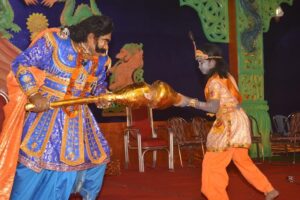
The 11-day narrative follows the Srimad Bhagavatam and Harivamsa storylines:
Cultural Impact & Visitor Info
Dhanu Jatra is not just a performance; it is an immersive embodiment of folk theater that showcases Sambalpuri music, folk dance, regional handlooms, and community solidarity.
-
When: December – January (Lunar month of Pausha).
-
Where: Bargarh, Western Odisha (approx. 330 km from Bhubaneswar, 40 km from Sambalpur).
-
Nearest Transit: Bargarh Road Railway Station; Jharsuguda Airport (~100 km) or Raipur Airport (~300 km).